


AdBlue tank failure on the Peugeot Boxer or Citroën Jumper: causes, costs and possible goodwill support
Problems with the AdBlue system are repeatedly reported on Peugeot Boxer and Citroën Jumper models with BlueHDi engines. We experienced the fault twice on our own vehicle, a 2018 Boxer L3H2 – first the injector, later the pump inside the tank. This article covers the typical fault codes, the most common cause, our own experience, repair costs, practical tips on additives, warning signs and refilling, what to look for when buying used, how an extended Stellantis support programme may help, and a security weakness at the filler cap that many owners do not know about.
Last updated: 21 July 2026
How can you recognise a problem with the AdBlue system?
In our case it was practically always the same: the onboard computer displayed “AdBlue system faulty, check engine”, and the engine warning light came on at almost the same time. At that stage it was still possible to continue driving.
This message is unambiguous and clearly different from the message shown when the fluid level is merely low, which says “Refill AdBlue”. “AdBlue system faulty” indicates an actual technical fault and directly advises visiting a workshop.
Typical fault codes: P20E8 and P20EE
When the fault memory is read, codes P20E8 and P20EE frequently appear in connection with AdBlue problems on Boxer and Jumper. Both concern exhaust after-treatment but point to different issues:
- P20E8 means “reductant pressure too low” – the delivery pump does not build the pressure expected by the control unit. This code fits a pump/tank fault such as the one described below.
- P20EE means “SCR catalyst efficiency below threshold” – the control unit detects that the SCR catalyst is not reducing nitrogen oxides sufficiently. There can be several causes, including insufficient dosing due to a blocked or faulty injector. In our case, the injector was the cause.
Important: both codes describe a symptom, not a definitive diagnosis. Whether the injector, pump, a sensor or the catalyst itself is affected can only be determined by more detailed workshop diagnostics.
The most common cause: the pump in the tank, not the tank itself
On Peugeot Boxer and Citroën Jumper models with BlueHDi engines, the AdBlue tank, delivery pump and sensors are installed as one assembly. This is also why a pump fault becomes so expensive: usually it is not the plastic tank itself that leaks or fails, but the delivery pump inside it – yet the manufacturer generally does not offer the pump as a separate replacement part. If it fails, the complete tank therefore has to be replaced even though only a relatively small component inside it is defective.
Our experience: first the injector, later the complete tank
For us, the problem occurred in two stages. First the AdBlue injector failed (fault code P20EE). This repair was still relatively inexpensive: the injector itself is not costly, and including labour we paid around €280.
Much later, at higher mileage, the delivery pump inside the tank failed (fault code P20E8). This time the entire tank had to be replaced. According to our workshop, the AdBlue injector should be replaced at the same time in such a case; otherwise deposits or incorrect dosing could cause new problems. We therefore had the injector replaced a second time as a precaution.
Looking back, we were almost surprised that the tank fault took so long to occur at our mileage. In many reports from other Boxer and Jumper drivers it appears considerably earlier.
Replace the tank yourself or flush it?
Before opting for a workshop repair, we spent some time researching whether the tank could be replaced ourselves or at least flushed. Refurbished tanks are available on eBay, for example, and can be somewhat cheaper than new parts.
Two things put us off. First, the tank is only accessible from underneath the vehicle. Second, the new components have to be commissioned or adapted in the system, which most likely requires the appropriate factory diagnostic tool (Diagbox). Private owners can buy Diagbox and suitable hardware from various sources, but the whole project eventually became too involved for us. We also found very few reliable reports of owners successfully carrying out the complete job themselves.
There are also YouTube videos about replacing only the pump. We could not establish whether such repairs had proven durable in the long term, so we ultimately chose the conventional workshop repair.
Cleaning the injector yourself
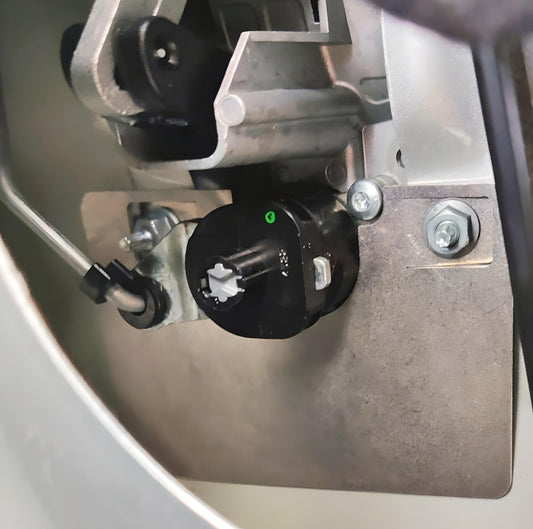
The AdBlue injector can gradually become clogged with AdBlue crystals. We have therefore cleaned it ourselves once instead of replacing it immediately. The injector sits at the inlet to the exhaust system. The easiest way to find it is to follow the line from the AdBlue tank towards the pump/injector, where there is a screw clamp. Once this is released, the injector can be removed. If heavily crystallised, cleaning can, in our experience, help for some time.
Important: this only addresses a clogged-injector problem, not a pump or tank fault; these have different causes. Anyone who is unsure or not comfortable doing this should have the system checked by a workshop.
Can an AdBlue additive help?
For a long time we added an AdBlue additive (Amazon affiliate link) intended to reduce AdBlue crystallisation. It is difficult to judge retrospectively whether it actually helped. After we stopped using it for a while, the tank fault occurred shortly afterwards. We cannot say whether there was a connection or whether it was coincidence. Subjectively, at least, it felt as though we were doing something proactive for the system. Ultimately everyone has to decide for themselves.
Note: on a vehicle still covered by factory warranty or an active warranty/goodwill programme for AdBlue components, we would be cautious about using an additive. In the event of a claim it could potentially lead to discussions. While our current tank remains covered by the repair warranty, we are therefore not using an additive ourselves.
Recognising warning signs: from the first message to limp mode
As long as only the fault message and engine warning light were present, we were able for a while to work around the issue using a simple OBD dongle. At this stage we cleared the fault several times simply to gain some time. Sometimes this helped for quite a while, sometimes the message returned immediately. Our workshop also cleared the code on several occasions, after which things were again fine for some time. Pump wear appears to develop gradually: repeated clearing may buy time, but eventually the fault becomes persistent.
Clearing a fault code is not a repair. At best it buys time; it does not remove the cause. Repeated warning messages should sooner or later be investigated by a workshop. If the problem is ignored for too long, the onboard computer may display a countdown (“engine start no longer possible in X km”), after which the vehicle will refuse to start until the fault is repaired. We never personally reached that point, but many Boxer and Jumper drivers report exactly this problem, which can be particularly unpleasant while travelling. The distance shown seems to vary, with reports often mentioning roughly 400 to 800 kilometres.
For travelling, we would recommend Boxer and Jumper drivers carry an inexpensive OBD diagnostic dongle (Amazon affiliate link). We use a simple dongle with the EOBD-Facile app on an iPhone, which works reliably with our Boxer. Without such a device, you may have no way of at least clearing the fault while away from home.
How serious is the warning?
In our experience, the cruise control provided a rough clue to severity: while cruise control still worked, the fault in our case usually was not yet severe. If cruise control could no longer be activated, that indicated a more serious engine fault. We would then try to have the code checked or cleared by a workshop as soon as possible rather than simply continuing to drive.
The next stage is limp mode. In our case, speed was then limited to around 50 km/h. In that situation we would not simply continue driving but stop safely at the next suitable opportunity. Sometimes restarting the engine helped; in our case, clearing the fault with the dongle usually allowed us to leave limp mode at least temporarily, even though the underlying warning often returned immediately.
How to refill AdBlue correctly
We now prefer filling AdBlue from a filling-station pump rather than using supermarket canisters. At a pump, the high turnover generally means the AdBlue is fresher because large volumes are also dispensed to trucks. Not every filling station has its own AdBlue pump, however.
Many sources advise against storing partly used canisters for long periods. We would therefore use an opened container relatively soon rather than keeping it for months.
It can also be sensible to fill the tank substantially rather than adding only a small amount. The level sensor seems to recognise the refill more reliably when the tank is filled more fully, so adding only a small quantity may not always be sufficient.
How much does the repair cost?
We already mentioned the injector alone: around €280. A pump/tank fault is much more expensive. In our case, tank, injector and installation came to approximately €1,700 in total. Peugeot now also offers refurbished/reconditioned tanks with a corresponding parts warranty, which may reduce the cost in some cases. The actual repair bill depends on the workshop, parts prices and whether the injector is replaced at the same time.
Extended cost support from Stellantis
Stellantis has introduced a voluntary extended support programme for certain problems involving AdBlue/urea tanks. It covers certain Peugeot, Citroën, DS, Opel and Vauxhall vehicles with Euro 6 diesel engines and SCR exhaust treatment produced between January 2014 and August 2020.
This is not full goodwill coverage for every affected vehicle. Depending on vehicle age and mileage, however, a substantial proportion of the replacement-part cost may be covered. Anyone affected should therefore ask an authorised dealer before the repair whether their vehicle qualifies; obtaining support retrospectively is generally more difficult.
Further information is available on Stellantis' official AdBlue tank support information page.
What should you check when buying used?
Anyone buying a used Boxer or Jumper with a BlueHDi engine should specifically ask whether the AdBlue tank or injector has already been replaced. A previous replacement is more positive than negative – it often means that a typical weak point has already been addressed. If there is no history, ask whether AdBlue-related warnings appeared during recent services and watch for corresponding messages in the onboard computer during the test drive.
One point many people overlook: according to several reports from affected owners, complete and on-time servicing at an authorised workshop may also play a role in Stellantis' support decision. Missing services or servicing not carried out on schedule by an authorised dealer are often mentioned as reasons for rejection. This is not stated explicitly in those terms on the official Stellantis page, but it corresponds with reports from several owners. When buying used, it is therefore worth checking the service book if future support may be relevant.
Security weakness: the AdBlue filler cap cannot be locked
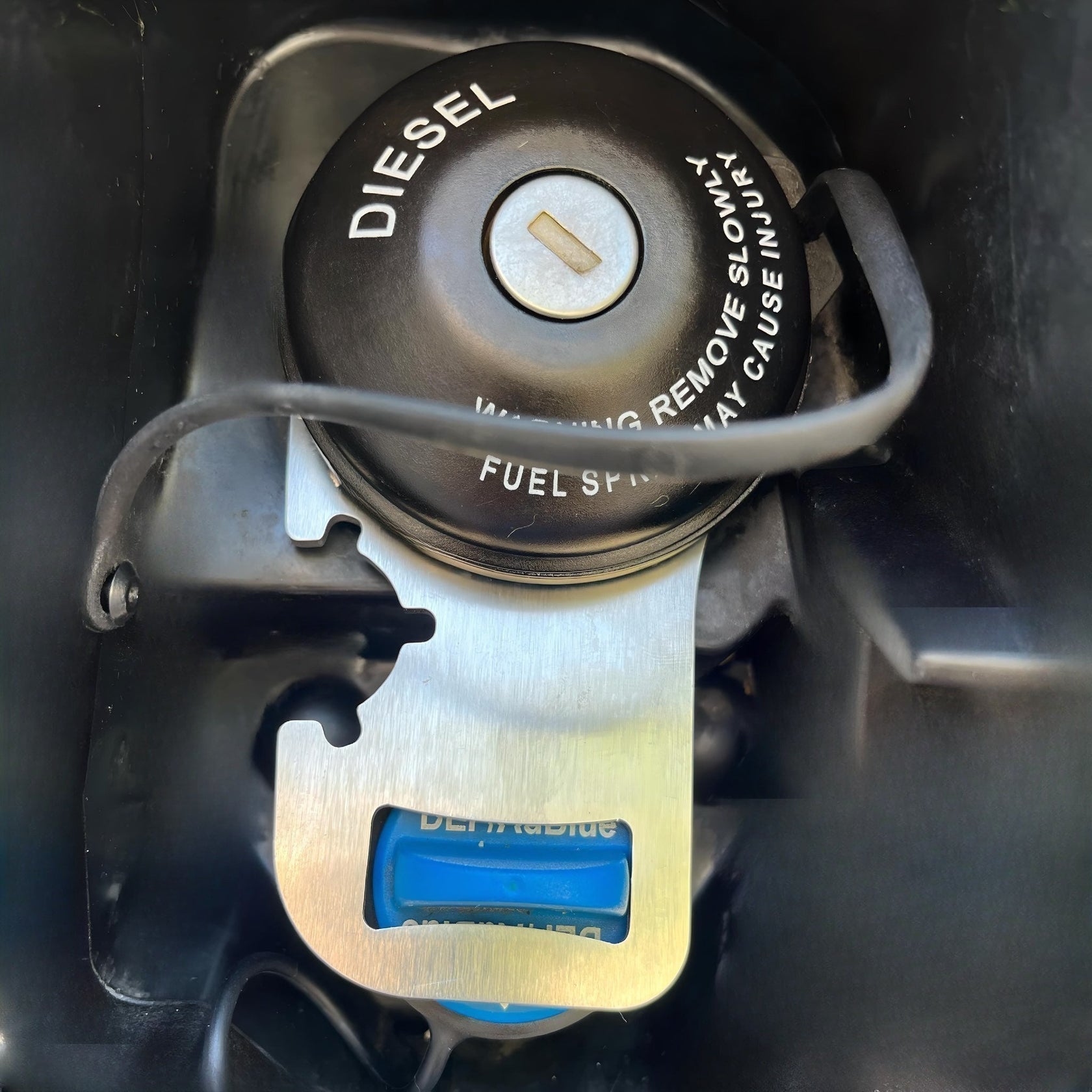
One weakness many Boxer and Jumper owners do not realise is that the AdBlue filler cap cannot be locked and is not controlled by the central locking system. Behind the fuel flap there is a lockable diesel filler cap, but the AdBlue filler below it is closed only with a blue plastic cap that anyone can open from outside.
For us this is particularly uncomfortable when parking in cities. Deliberately introducing a foreign substance into the tank could cause expensive damage to the exhaust treatment system, and theft of AdBlue is theoretically possible even if the quantity is limited.
We therefore secure our tank with an AdBlue protective bracket from our own shop. The bracket is installed behind the lockable diesel filler cap; once the diesel cap is locked, the bracket also blocks the AdBlue cap. Installation requires no modification to the vehicle. It is available in black powder-coated steel or stainless steel with an integrated gas-cylinder key, and both versions also fit the slightly angled AdBlue caps on newer model years. The solution is not suitable for fully integrated motorhomes, where the fuel and AdBlue filler positions are usually different.
Frequently asked questions about AdBlue problems on Boxer and Jumper
How much does an AdBlue tank replacement cost on a Peugeot Boxer or Citroën Jumper?
In our case, tank, injector and installation came to approximately €1,700. Actual costs depend on the workshop, parts prices and whether the injector is replaced at the same time. Refurbished tanks with a parts warranty can reduce the cost.
Why does the complete tank often have to be replaced if only the pump has failed?
The delivery pump forms part of the AdBlue tank assembly and is generally not supplied separately by the manufacturer. A failed pump therefore normally means replacing the complete tank.
Is there a goodwill/support programme for the AdBlue tank?
Yes. Stellantis offers a voluntary extended support programme for certain Peugeot, Citroën, DS, Opel and Vauxhall vehicles with Euro 6 diesel engines and SCR treatment produced between January 2014 and August 2020. Eligibility and the amount covered should be clarified with an authorised dealer before the repair.
How do I recognise an AdBlue-system fault?
In our case the onboard computer displayed “AdBlue system faulty, check engine” and the engine warning light came on at the same time. This differs clearly from “Refill AdBlue”, which only indicates a low level. “AdBlue system faulty” indicates a technical fault.
Do all services need to have been carried out by an authorised workshop for Stellantis support?
The official Stellantis page does not state this explicitly in those terms, but several owner reports suggest that complete, on-time servicing at authorised workshops can play a role and that missing evidence may be cited in rejections.
Does the injector have to be replaced when the tank is replaced?
Not necessarily, but it is often recommended when a malfunction has already occurred, to reduce the chance that deposits or incorrect dosing cause further problems. On our vehicle the injector was replaced again as a precaution.
What do fault codes P20E8 and P20EE mean?
P20E8 means “reductant pressure too low” and often fits a pump/tank fault. P20EE means “SCR catalyst efficiency below threshold” and can, among other causes, result from a blocked or faulty injector. Both codes describe symptoms; detailed diagnostics are required to determine the actual cause.
Can I clean the AdBlue injector myself?
The injector sits near the inlet of the exhaust system and can be removed after releasing its clamp. If clogged with AdBlue crystals, cleaning can help for a while. This only helps with a blocked injector and not with a pump or tank fault.
Does an AdBlue additive help prevent tank failure?
It is difficult to judge reliably. We used an anti-crystallisation additive for a long period but cannot say whether it delayed the fault. On vehicles covered by a factory warranty or support programme for AdBlue components, we would be cautious about additives.
What should I do if the vehicle enters limp mode because of an AdBlue fault?
In our case speed was limited to around 50 km/h. We would stop safely at the next appropriate opportunity rather than simply continuing. Restarting the engine or clearing the code with an OBD dongle sometimes temporarily removed limp mode for us, although the underlying fault remained.
Why can't the AdBlue filler cap be locked?
On Boxer, Jumper and related vehicles, only the diesel filler cap is lockable; the blue AdBlue cap below it can be opened from outside. A protective bracket mounted behind the diesel filler cap can block the AdBlue cap at the same time when the diesel cap is locked.

